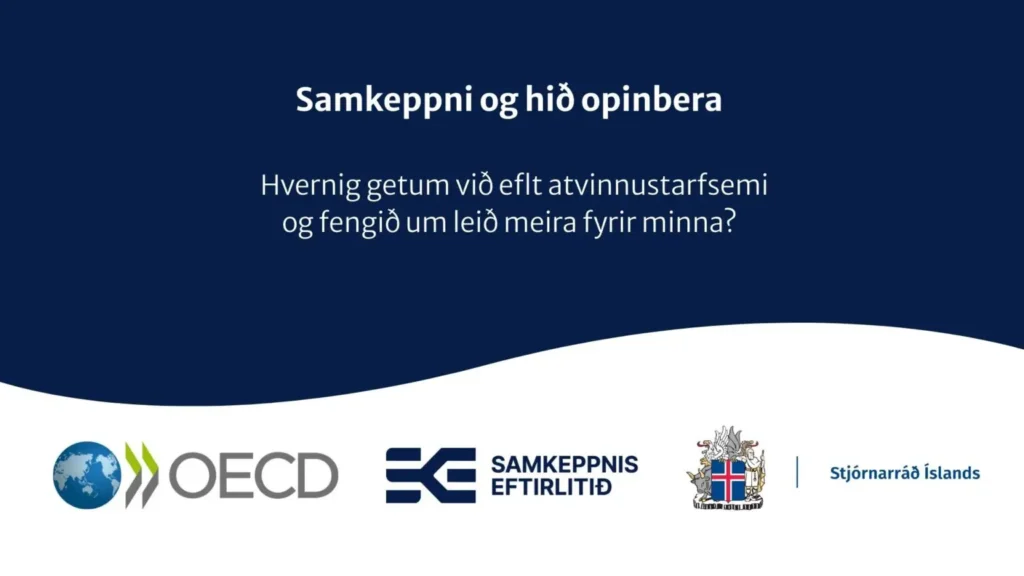
A strong and competitive business sector is a fundamental prerequisite for welfare in Iceland. To that end, it is important that the business community does not face a heavier regulatory and administrative burden than is necessary. On 19 February, the Competition Authority, the Cabinet Office and the OECD held an open meeting entitled „How can we boost business activity and get more for less?” Recordings of the conference are available on the Competition Authority's website.
A presentation by Federica Maiorano, a specialist in the OECD's competition division, revealed that the organisation's extensive review of the regulatory frameworks of its member states shows that competitive barriers in Iceland are considerably higher than the OECD average. By comparison, the regulatory framework of the other Nordic countries is more pro-competitive than the average. An OECD report from 2025 on the economic situation in Iceland states that by reducing the burdensome regulatory and administrative burden, Iceland's Gross Domestic Product could be increased by approximately 6.5% over a 10-year period. Therefore, there is much to be gained.
Competitive assessment
The Competition Authority has long pointed out the importance of applying the so-called competition assessment when enacting laws and regulations in this country. Competition assessment is a methodology that the OECD has recommended its member states use to identify competitive barriers in regulation. By avoiding and removing such barriers, it is possible to open up markets, strengthen competition and reduce regulatory burden.
To promote the further implementation of competition assessment in Icelandic law and regulation-making, the Competition Authority held a successful workshop on 17 February with managers and staff from ministries and agencies involved in the formulation and enactment of regulations. The workshop included a detailed review of the OECD's Competition Assessment Toolkit.
Competition assessment can be applied not only when preparing new laws and regulations, but it is equally important to remove barriers to competition from existing legislation. At the request of the Icelandic government and in cooperation with the Competition Authority, the OECD conducted a detailed analysis of the regulation of the construction and tourism industries, and a report with the organisation's findings was published at the end of 2020.
OECD recommendations
In the report, the OECD put forward 438 recommendations for regulatory changes, of which 122 concerned the tourism sector and 316 concerned the construction industry. The OECD estimated that the regulatory simplification implied by the recommendations could lead to an increase in GDP equivalent to around 1.1 per cent of GVA.
The importance of strengthening the tourism sector need not be overstated. Competition in aviation and all commercial activity related to the operation of Keflavik Airport and other vital infrastructure is essential for a robust tourism industry in this country. Similarly, the simplification of regulations in the construction industry is designed to reduce housing costs. Simplifying planning rules and the processes for preparing and issuing building permits is part of this.
The current government has emphasised regulatory simplification. Last autumn, the government also introduced a so-called housing package, which is intended, among other things, to lower housing costs. Part of these measures is to simplify the regulations in this area. The above-mentioned OECD proposals can be of great use in these measures, but they have only been partially implemented.
In these areas, as well as in various other areas of business, there is an opportunity to improve, increase the competitiveness of Icelandic business, and thereby promote more effective competition for the benefit of all.
Margrét Einarsdóttir, Chairperson of the Competition Authority, and Páll Gunnar Pálsson, Director of the Competition Authority.
This post was published as an article on visir.is on 26 February 2026.,
"*" indicates required fields