The article was first published in Viðskiptablaðið on Wednesday, 20 November 2024.
In recent months, the public debate has focused on the costs that inevitably arise from the supervision of various activities in this country. It is natural and healthy to discuss ensuring that supervision costs do not become excessive. However, in such a discussion, it is important not to forget the other side of the coin, which is that there is a societal benefit to having oversight and to complying with the laws and regulations of society. However, it is often more difficult to assess that benefit than the cost of such oversight, which may explain the limited discussion of the societal benefits of oversight.
In the interest of an informed discussion, a summary of the findings from an evaluation of the benefits of competition law enforcement in Iceland since 2005 is provided, based on the Competition Authority's latest report No. 4/2024., Calculated benefit from the Competition Authority's intervention 2014-2023. Have foreign sister institutions, e.g. the Competition Directorate of the European Commission and the British and Dutch competition authorities, carried out such analyses in recent years.
Assessment of the estimated benefits of competition law
The Competition Authority's analysis aims to assess the estimated benefits of the Authority's intervention under competition law, and is based on the methodology described in the 2014 guidelines of the Organisation for Economic Co-operation and Development (OECD). A guide to help competition authorities assess the expected impact of their activities. The analysis and its methodology are peer-reviewed.
The fundamental premise of the OECD Guidelines is that breaches of competition law by companies, which include, for example, through consultation or abuse of a dominant position, or mergers that distort competition, will generally lead to higher prices and poorer quality in the relevant market than in a market where competition is effective. Through their intervention, competition authorities prevent the higher prices and lower quality for customers in the relevant market from becoming permanent.
The calculated benefit is therefore an assessment of the harm that customers would have suffered had the intervention of the competition authorities not taken place. Customers can be either consumers or other businesses. However, the analysis is not intended to provide a comprehensive assessment of the macroeconomic benefits of competition enforcement. It does not take into account the various positive effects that effective competition can have, such as increased innovation and greater macroeconomic efficiency of the economy. Furthermore, the loss of revenue for companies resulting from the cessation of anti-competitive conduct is not taken into account.
Research on the effects of competition law infringements suggests that the assumptions used are conservative, but this is discussed in more detail in the Competition Authority's report. No. 3/2024.
The calculated benefit amounts to multiple financial contributions to the organisation.
The results of the analysis for the Competition Authority's interventions up to the end of 2023 were published last September, but the Competition Authority's analysis dates back to 2005, when the Competition Authority began its operations in its current form. The results are published as a 10-year average to smooth out year-on-year fluctuations.
The calculated benefit of the Competition Authority's intervention over the ten-year period 2014-2023 was equivalent to 17-29 times the institution's funding over the period, or approximately 10.7-17.7 billion krónur per year on average, at 2023 prices.
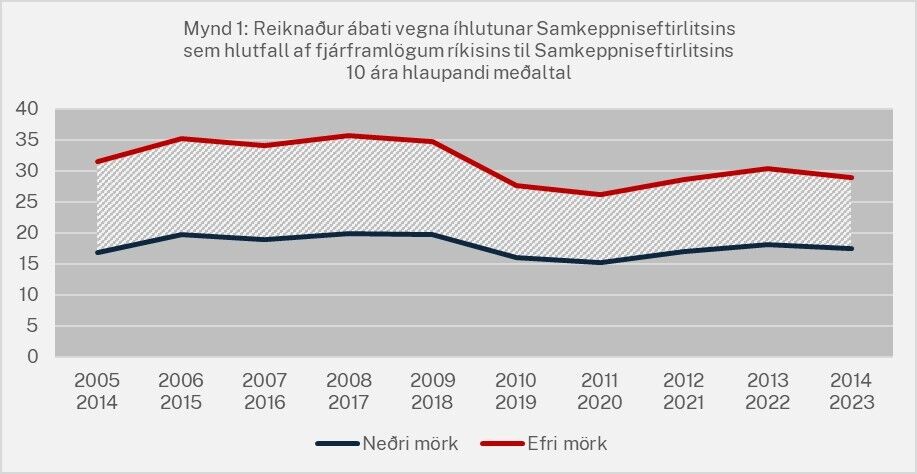

As can be seen from Figure 1, the 10-year average of the calculated benefits has remained relatively stable. The annual average estimated benefit from the Competition Authority's interventions was lowest during the 2011-2020 period, when it amounted to 15-26 times the state's financial contribution to the institution, or approximately 8.8-15.1 million króna. on average each year. The calculated benefit was highest during the 2008-2017 period, when it amounted to 20-36 times the state's funding for the authority, or approximately 10.9-19.5 billion króna on average each year. Amounts are in 2023 prices.
Finally
In the discussion of supervision in this country, it is important to consider the benefits that public supervision delivers, as well as the costs it entails. In the case of competition law enforcement, the societal benefits are manifold compared to the costs, but the estimated benefits of the Competition Authority's interventions over the ten-year period 2014-2023 amounted to 17-29-fold the financial contributions to the authority, or around 10.7-17.7 billion krónur annually on average. Proper prioritisation of public funds is important, but care must be taken not to pinch pennies and throw the króna away at the same time.
Atli Rúnar Kristinsson is an economist at the Competition Authority.
Valur Þráinsson is the chief economist at the Competition Authority.
"*" indicates required fields