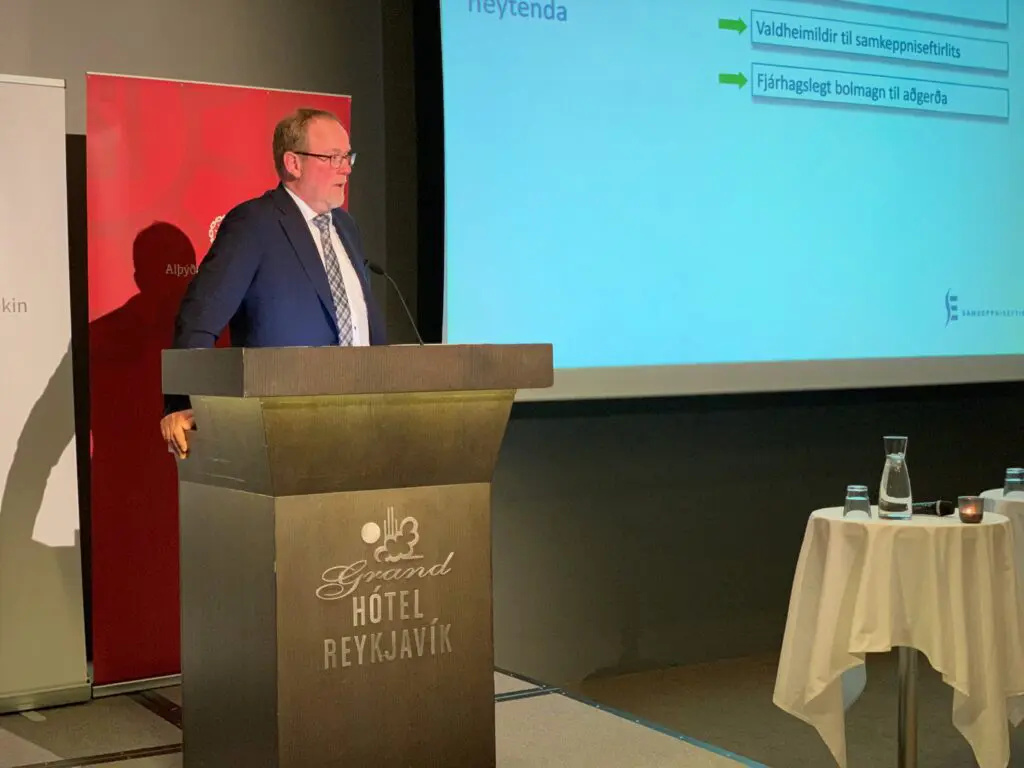
Speech by Páll Gunnar Pálsson at the meeting of the Price Monitoring of the ASÍ and the Consumers' Association on competition and consumer affairs.
(Slides from the presentation accompanying the speech can be accessed here)
Dear attendees,
In most homes, there are always bits and pieces that need mending, and it can be useful to have a tool that is suitable for a variety of jobs. In this respect, the needle-nose pliers, or „wise-grip“ pliers, were a major innovation when they were first introduced; and they are still an essential tool today for loosening screws and other items. The WD-40 spray is no less useful, loosening all the rust and freeing old screws and other stuck-on parts.
But the country's households have another such necessity, even better, which in everyday parlance is called „effective competition“.
Effective competition in business life is not only important for ensuring that consumers and other customers receive goods and services at a good price and of high quality, but it is also recognised that it has much wider significance:

All this combined creates benefits for consumers and businesses, whilst simultaneously increasing economic dynamism and supporting the competitiveness of nations.
It would be great if all of this could be had in one spray can [cf. the aforementioned WD-40 spray], but it is not that simple. For a small nation like ours, creating the conditions for effective competition is easier said than done. And what's worse: in a small economy, the harm to consumers from barriers to competition is magnified.
As is often the case, it is useful to look around us and see in which direction our trading nations are heading now.
Let us first look to the west. There, major measures are being taken in the field of competition policy. The US government plans to tackle economic stagnation and worsening consumer welfare by promoting competition in as many sectors as possible. There is talk of tackling the dominance of large corporations in a similar fashion to how Roosevelt did early in the last century. Particular focus is being placed on boosting the interests of working people by laying stronger competitive foundations for the American economy.
This summer, a detailed presidential decree was issued, announcing major changes in the field of competition policy. A number of institutions are being called upon to act to improve the competitive environment in various sectors of economic life, such as financial services, healthcare and agriculture.
Last but not least, a significant strengthening of competition supervision is announced, along with a policy shift towards stricter merger control, in order to counter concentration and, possibly, to break up corporate conglomerates that have been allowed to grow over recent decades under the shelter of a cautious application of competition law. Stricter measures against breaches of competition law are also planned.
To our south, the British are finding their feet in a new environment following their withdrawal from the European Union. One might think that the British government would take the opportunity to shield the country's economy from European competition.
However, that is not the case at all. This summer, the British government published a detailed policy for consultation in the field of competition and consumer affairs. It places emphasis on improving consumer welfare through the strengthening of competition rules and competition enforcement. Although the UK's competition authorities are considered to have delivered significant benefits, a strengthening of competition enforcement is proposed in most areas, including merger control, the enforcement of competition law infringements and market investigations. If the UK wants to create a world-class economy, its competition and consumer policy must also be world-class.
In addition, the British government has introduced new legislation to tackle the power of large digital companies and ensure they face effective competition.
In mainland Europe, measures have long been in place to ensure effective competition for the benefit of consumers and national economies. In 2014, the European Union established a specific directive aimed at making it easier for businesses and consumers to seek compensation from companies that breach competition law. Among other things, the directive facilitates the gathering of evidence and the proof of infringements.
In 2019, a directive came into force which aims to strengthen the competition authorities of European Union member states, often referred to as ECN+. It sets minimum requirements for the investigative powers that competition authorities have at their disposal and promotes the harmonisation of sanctions in individual Member States, both in terms of their framework and the amount of fines. It also provides for the harmonisation of rules on the reduction or remission of fines when companies come forward and provide information about an infringement and/or assist with an investigation.
Last but not least, the directive provides for the independence of competition authorities, both in their supervision and decisions, while also ensuring they have sufficient resources to carry out their role.
And last year, the Commission began work on strengthening its resources to tackle new challenges, not least in the field of financial markets.
It is clear from this that our trading partners have adopted a clear policy of strengthening competition, thereby providing a firmer foundation for consumer protection and the welfare of their respective countries.
If we are not to be second best to our trading partners, we need to do the same.
It is interesting, in this light, to observe the recent media debate on competition policy and consumer protection in this country. A prominent theme is that there is a danger here of the competition authority unduly infringing on the interests of commercial enterprises. Within business interest groups, there is even talk of the need to exempt certain industries from the provisions of competition law, including allowing collaborations and mergers that would otherwise be prohibited under competition law.
However, there is less discussion about whether competition law and competition supervision provide sufficient protection for consumers, in light of the policy-making of our trading partners, as I have outlined above.
Consumers, however, are aware of their interests in active competition. At this meeting, a survey by the Consumer Association and the ASÍ has been described, which indicates that Icelanders are by no means inferior to the inhabitants of neighbouring countries in consumer awareness.
A similar story is told by a survey that the Competition Authority commissioned in 2019 on public knowledge and attitudes towards competition. The survey is based on a survey that the European Commission had conducted in all member states of the European Union, and therefore the results can be compared.
It states that 97% of respondents believe that effective competition has a positive effect on them as consumers. On average, 83% of consumers in the EU answered this question in the affirmative. Icelandic consumers are most aware of competition problems in financial services, the food market and passenger transport. In the EU survey, however, telephone and internet services, the energy market and the pharmaceutical market topped the list.
Consumers here in the country also pay close attention to competition matters. Around 70% of respondents had heard or read about competition matters or investigations in the past 12 months, compared with 40% in the EU.
The Competition Authority also conducted a survey among company executives around the turn of 2019/2020. Its findings suggest that company executives are generally very concerned about competition in their sector. Thus, 35% of executives considered themselves to be aware of the abuse of a dominant position in their market to some, a rather large, or a very large extent. 28% aware of illegal collusion in their market and around 25% managers of competition-restrictive laws or regulations.
Dear attendees,
I would like, finally, to examine the framework for competition policy in this country from the perspective of consumer protection and compare it with the best practices around us and the policy direction I outlined earlier. A number of points in this regard can be noted:
Firstly, the institutional framework for competition enforcement must be adequate. This includes an independent Competition Authority with a clear focus on the enforcement of competition law. It is part of a European network of competition authorities that enforce the same or similar substantive rules, and the European Commission and the ESA ensure uniformity of application.
An appeals board operates within the supervisory authority, and the courts have proven to be active in shaping competition law. Consequently, a very diverse range of decisions has been established here, and these precedents provide a solid foundation for the enforcement of competition law.
It should also be noted that the Competition Authority is working to strengthen cooperation with domestic institutions in the fields of economic affairs, economic crime, consumer affairs and market surveillance. This is intended to increase efficiency and improve the resolution of issues.
All of this indicates that the institutional framework for the enforcement of competition law is in rather good shape.
Secondly, competition law must provide adequate tools for its enforcement. The competition authority has the main powers that its sister authorities have. However, at least two matters need to be addressed. For instance, the authority does not have all the powers to obtain evidence where it is found, as required by the EU Directive; instead, it can only obtain documents at a company's premises. Furthermore, the authority must consider the amount of administrative fines in light of developments in the European Economic Area. A survey of company directors indicates that the deterrent effect of administrative fines is not sufficient.
Thirdly, the financial capacity of the Competition Authority to carry out its statutory duties must be considered. The authority has around 25 full-time equivalent staff. It is obvious that this is not much. Experience also shows that the authority has had to prioritise its work more than is desirable.
The prioritisation is largely determined by the workload involved in merger investigations. The Competition Authority has no control over when or how many merger notifications are received. Due to statutory deadlines, it always prioritises these at the expense of other cases, such as investigations into breaches of competition law or public competition restrictions.
Recently, there has been considerable discussion about the efficiency of the supervisory authority in investigating merger cases. That discussion is useful. My concerns, however, are more about the authority's capacity to deal with other matters. The Supervisory Authority has called for a discussion on this and requested that ways be sought to increase flexibility in funding. This would allow funding to be increased during periods of high demand for merger investigations, so that other projects do not have to suffer for it. The Ministry of Competition has shown an understanding of this, but a permanent solution has not yet been found.
Fourthly, one of the most pressing tasks ahead is to ensure that consumers and businesses that suffer damage as a result of competition law infringements enjoy the same rights to claim compensation as consumers and businesses in EU states. Here, we have not adopted the substantive rules of the EU damages directive. Such rules increase the deterrent effect of competition law, but the executive survey I mentioned earlier shows that damages awards have an even greater deterrent effect than administrative fines.
Fifthly, consumer protection and advocacy for consumers need to be better supported. We can look to the other Nordic countries, where the government supports independent consumer organisations more robustly than has been the case here. Strong consumer representation increases consumer scrutiny of both businesses and regulatory authorities. It also creates an important counterbalance to the lobbying efforts of businesses. The government must ensure a greater balance between these interests.
Finally, it must be ensured that all government agencies promote the interests of consumers through active competition. They can do this, for example, by ensuring that laws, regulations and other government measures do not create barriers to competition.
Active competition is not, in fact, the sole responsibility of the Competition Authority, but a matter for all of us.
Thank you.
"*" indicates required fields