 The Competition Authority and the Exchange have made comprehensive agreement on the conclusion of the matters that the supervisory authority has been investigating. The settlement provides for extensive changes to the structure and conduct of the Skipta Group with the aim of strengthening competition. The settlement also ensures that Telenor's competitors are on an equal footing with Telenor itself regarding access to Skipta's basic telecommunications networks. This goes further in separating a former telecommunications monopoly than is customary in neighbouring countries. Skipti also agrees to pay a government fine of 300 million króna.
The Competition Authority has been handling various complaints from competitors of Síminn, in which it has been alleged that Síminn has breached the competition law prohibition on the abuse of a dominant position. Furthermore, in recent years, rulings and judgments have been issued concluding that companies within the Skipta Group have breached provisions of the Competition Act.
Provisions of competition law allow the Competition Authority to conclude cases with a settlement with companies under investigation. This way, remedies for competition concerns can be implemented sooner than would otherwise be the case. In September 2012, Síminn submitted a request to the Competition Authority, asking for talks on whether it would be possible to conclude the cases then before the Authority with a global settlement. The negotiations led to a settlement, which was signed on 8 March 2013. In preparing the settlement, the Competition Authority had close cooperation with the Post and Telecommunications Authority (PFS). The terms of this settlement are set out in the Competition Authority's decision, which is published today.
Í the settlement Lessons are drawn from the cases under investigation, past cases, and the competitive effects of the Telecoms Group's position in the telecommunications market. The settlement entails significant changes to the structure of the Group, and thereby to the Icelandic telecommunications market. In this context, it should be borne in mind that fThe telecommunications operators of Skipta (Landssími Íslands/Póst- og símamálastofnun) had a monopoly on telecommunications operations for decades and, under the protection of that position, built a widespread and powerful telecommunications network. Competition in telecommunications was fully liberalised in 1998 and Landssíminn was privatised in one go in 2005, i.e. the basic network was not separated from the company.
Therefore, exchanges are owner of a nationwide basic telecommunications network, which has given the Group a significant advantage. In order to compete in the telecommunications market, competitors need access, to a greater or lesser extent, to the basic telecommunications network. As a result, competitors of Skipti are inevitably customers of the Group. This arrangement has created a persistent risk of serious anti-competitive effects and conflicts of interest, including the risk that Síminn's retail arm benefits from better terms, service or quality regarding access to the core network than its competitors. This also created a risk of misuse of confidential information and that Síminn's retail arm would gain an advantage regarding essential information related to the core network. The Competition Authority considers that the actions of Skipta in older cases that have contravened competition law have, in one way or another, many of their roots in the aforementioned structure of the group, both past and present.
The settlement establishes, for the first time, a clear and definitive separation between, on the one hand, the Group's core networks and the services provided to telecommunications operators in connection with these core networks, and on the other hand, Síminn's retail business. Under the settlement, Skipti and its subsidiaries are bound by detailed conditions that ensure this and thus prevent Skipti's position in basic telecommunications from being used to create an unfair competitive advantage for the company. The settlement therefore seeks to ensure that Síminn and its competitors are on an equal footing with regard to access to basic telecommunications networks and the purchase of telecommunications services from the group at a wholesale level.
The Competition Authority's decision notes that in various European countries (e.g. the UK and Sweden), measures have been taken to change the structure of telecommunications companies that previously enjoyed a monopoly. The aim of these measures has been to promote competition, inter alia by ensuring equal access to basic networks. In the case of Skipta, it is necessary to go further in such separation than in neighbouring countries. The reason for this is not least the lesson to be learnt from past cases where competition law has been breached.
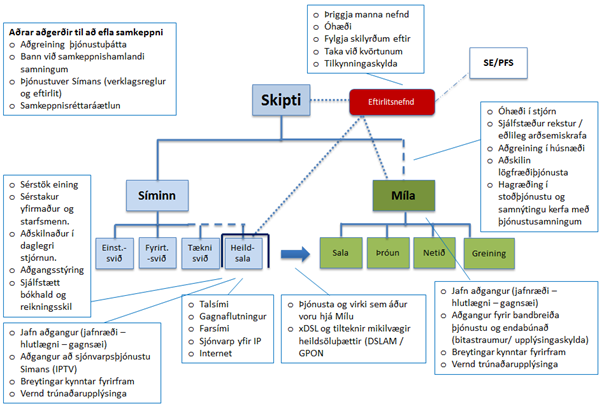
The core of the instructions which the Parties have committed to comply with under the Agreement can be summarised as follows:
According to the Competition Authority eThe settlement is designed to foster a much healthier competitive environment and significantly boost competition for the benefit of consumers and business. Affordable, efficient and reliable telecommunications are vital to society.
In the settlement, Skipti do not admit to a breach of competition law. The Competition Authority, however, considers that Síminn has abused its dominant market position. It is therefore necessary for Skipti to pay a fine and to implement the aforementioned measures to promote competition and prevent further breaches. However, as Skipti is prepared to do so, it is not necessary to take a final position on the extent of Símans's infringements or their substance in any other respect. The settlement provision of the Competition Act allows the Competition Authority a certain degree of discretion in this regard. The Competition Authority's assessment, based in part on discussions with the PFS and companies in the telecommunications market, is that the primary benefit to competition in this case is the fundamental structural changes to the telecommunications market achieved by the settlement with Skipti.
Background information:
Skipti is the parent company of Síminn and Míla. Síminn's operations consist mainly of providing telecommunications services, which are sold at retail to households and businesses. Míla manages the operation and development of the group's core telecommunications network.
This image sheds light on the provisions contained in the agreement:
The parties to the cases concluded by the settlement are, in addition to Síminn, Nova, Vodafone, Tal, Hringiðan and other companies that are members of Inter, an association of companies in internet services. Before substantive settlement negotiations began, the Competition Authority held discussions with these parties in order to ensure the settlement would achieve maximum effectiveness. Once the draft final settlement was available, its contents were presented to these companies and they were given an opportunity to make comments on the draft. The settlement concludes the handling of a total of seven cases.
As previously stated, the settlement also draws lessons from older cases. For context, the following recent cases may be noted:
"*" indicates required fields