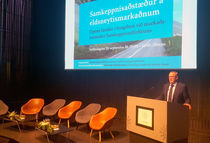
 The Competition Authority held a public meeting on the competitive conditions in the fuel market. The meeting is part of an ongoing market investigation. Well over one hundred people attended the meeting.
The meeting led to a useful discussion about possible barriers to competition and potential improvements to the market. The discussion was based on the preliminary assessment report of the Competition Authority, which was published at the end of last year. Daði Már Kristófersson, Dean of the Faculty of Social Sciences at the University of Iceland, chaired the discussions in two panel sessions, see more programme. The chair was Guðrún Ragnarsdóttir, chair of the board of the Competition Authority.
Four of the following videos were played at the meeting:
Summary interviews conducted by the Competition Authority with the director of the German competition authority, representatives of the British and Portuguese authorities, and Severin Borenstein, a professor of economics at the University of California, Berkeley. The interviews are also available in full on the Competition Authority's website.
Summary on the main findings of the Competition Authority's preliminary assessment report.
Summary on stakeholders' perspectives on barriers to access and coordinated behaviour.
Summary on stakeholders' perspectives regarding price comparisons, mark-ups, profitability and possible improvements.
On the Competition Authority's website, there are also interviews with Frosta Ólafsson, Director General of the Chamber of Commerce, Hermann Guðmundsson, Managing Director of KEMI, Johannes Gunnarsson, chairman of the Consumers' Association and Tryggva Axelsson, Director-General of the Consumer Authority.
Further information about the meeting can be found at Home page The Competition Authority.
Next steps:
It is now for the Competition Authority to take a more detailed position on the preliminary assessment set out in the aforementioned report, with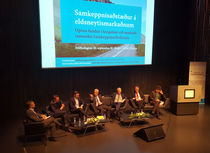 a reference to the views and evidence that have been gathered recently. Broadly speaking, the outcome of the monitoring can be one of three:
Firstly, the supervisory authority may consider it necessary to prepare for intervention in relation to specific circumstances. If this is the case, the supervisory authority will investigate that aspect of the matter in more detail, issue a statement of objections to the parties to that investigation, and then make a decision.
Secondly, the supervisory authority may issue recommendations for changes to the government or businesses due to specific market conditions.
Thirdly, the conclusion may be that no further consideration by the Competition Authority is necessary. The reason for this may, for example, be that the authority has changed its initial assessment due to views expressed, that circumstances have changed, or that the necessary resources are not available.
 At this stage, the outcome of the monitoring can be any one of these three, or a combination of all three approaches.
The Competition Authority aims to have a decision on these next steps reached and presented around the turn of the year. The views expressed will be of great use in shaping that decision.
"*" indicates required fields