Monday
13 June from 08:15 to 09:45 | In Harpa and live-streamed | Register here
On the occasion of
meeting of the chief economists of European competition authorities in Harpa
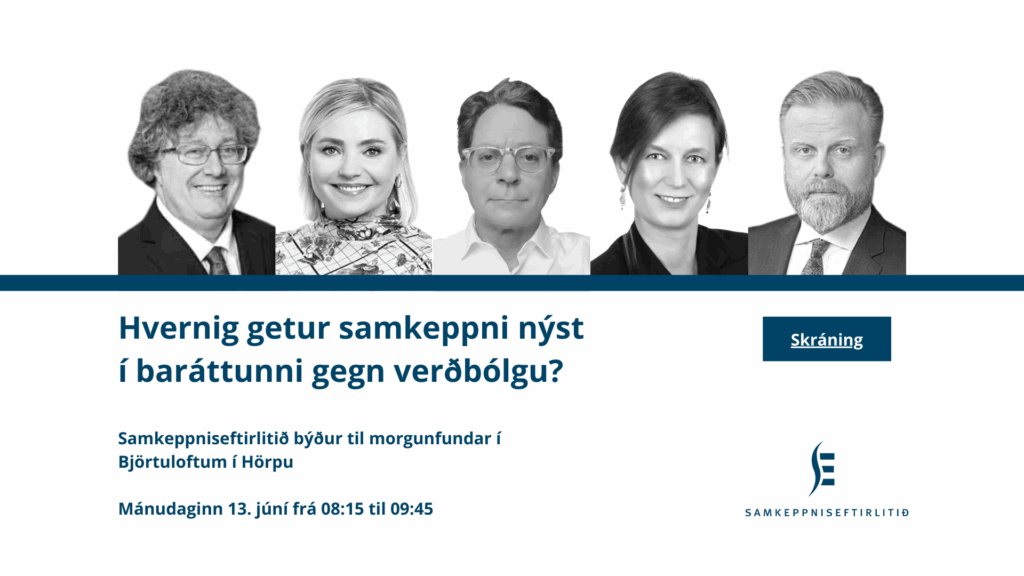
The Competition Authority's open morning meeting on the interplay between competition, inflation and
Purchasing power on Monday, 13 June.
Lilja Dögg Alfreðsdóttir,
Minister for Culture and Commerce, delivers the opening address at the meeting and Pierre
Régibeau, Chief Economist, Competition Directorate, European Commission
of the European Union, will deliver a speech. He will discuss what impact competition and
Competition authorities can have an impact on inflation.
and purchasing power. Increased inflation is a concern worldwide this autumn as
It can reduce the purchasing power of households.
Also, you can
Expect lively panel discussions featuring some fantastic guests:
Access to
The meeting is free of charge. You can participate online or attend in person at Harpa.
and take part in discussions about competition matters over a steaming cup of coffee. In both
In cases, it is necessary to Sign up here.
The meeting is
held in conjunction with the annual meeting of chief economists of competition authorities on
the European Economic Area, but the Competition Authority is the host this time.
Agenda:
Ana Sofia Rodrigues has worked as
Chief economist of the Portuguese Competition Authority (AdC) since October
2015 after a year at the OECD where she worked as a specialist in
competition law. Prior to that, she held various positions at AdC. Ana Sofia completed
PhD in Economics from the University of York in 2008.
Ásgeir Jónsson was appointed Governor of the Central Bank in the year
2019. Before that, he worked as President of the Faculty of Economics at the University of Iceland.
Ásgeir completed a master's degree in economics from Indiana University in 1997 and
PhD in Economics from the same school in 2001.
Lilja Dögg Alfreðsdóttir has been a member of the government
of Iceland since 2016, but she took over the Ministry of Culture and Commerce in
November 2021. Before being elected to Althingi, Lilja held various positions.
for both the Central Bank of Iceland and the International Monetary Fund in Washington D.C. in
United States. Lilja holds a master's degree in economics from Columbia University in New York.
York.
Martin Gaynor is a professor of economics at Carnegie
Mellon University in the United States. He is the former head of the economics department.
The Federal Trade Commission of the United States of America. Martin
has been prominent in research on competition policy (e. competition
policy) and competition in the healthcare sector. He completed a PhD in economics
from Northwestern University 1983.
Páll Gunnar Pálsson has been a director
of the Competition Authority since 2005. Páll Gunnar is a lawyer by training.
Pierre Régibeau is the chief economist of the competition department
of the European Commission. In his research, he has focused on industrial economics,
law and economics and international trade. Pierre completed his doctorate from
the University of California, Berkeley in the United States. He has also taught at
MIT, Northwestern University and the University of Barcelona. Today he holds
the position of Honorary Professor at the University of Essex.
Sveinn Agnarsson is chairman
Competition Authority, but he works as a professor at the Faculty of Business Administration
University of Iceland. Sveinn completed a foundation degree in history from the University of Iceland and
Doctorate in Economics from the University of Gothenburg.
Valur Thráinsson has been chief economist
the Competition Authority since 2019. Valur completed a foundation degree in economics from
University of Iceland, Master's degree in Economics from the University of Amsterdam and a diploma degree
in European Competition Law from King's College London.
Inflation
has increased steadily worldwide in recent months. The consumer price index in
The OECD countries rose by 8.81% year-on-year in March this year and by 7.8% in
February, compared with a 2.41% rise in March 2021. The increase in March was the largest
since October 1988. In a fifth of OECD countries, inflation has reached double digits.
than in Turkey where inflation is 61.11%. However, it does not look
that inflation has peaked. For instance, The Bank of England believes that
inflation will reach 10.1% later in the year according to the bank's updated forecast, which was published
in early May this year. The Central Bank of Iceland predicts that inflation in the country
will be 8.1% in the third quarter of 2022 and a similar story can be told worldwide.
This development
has led to a so-called cost-of-living crisis in various
countries. Wages then fail to keep pace with rising inflation, which leads to a decline in purchasing power.
household purchasing power, which has serious consequences for the general public.
Often
little is discussed about how competition and competition law enforcement can be utilised when
inflation increases or purchasing power decreases. It is, however, generally recognised that
Healthy competition in markets has a positive effect on living standards and prosperity. On the other hand
On the other hand, monopoly and a lack of competition can have the opposite effect.
Government
President Joe Biden has placed a strong emphasis on strengthening
competition authorities to respond to increased inflation. Regulatory authorities
have been advised to increase monitoring of competition, especially in markets
where competition has been low or significant concentration has occurred.
In addition
It is worth mentioning that active competition between companies can improve the position of workers. Competition authorities
in Europe, the European Commission and competition authorities in
The United States has intervened in markets where harmful mergers or
other anti-competitive conduct would otherwise have had a negative impact on
staff and their pay.
Therefore, it is
a genuine need for an open discussion about how competition and competition law enforcement
can be useful in the fight against rising inflation and for increased
purchasing power.
"*" indicates required fields