
Definition
Act No. 14 of 2011 amended the Competition Act in order to strengthen the Act and promote competition. This included, amongst other things, the addition of a new paragraph (c) to the first subsection of Article 16 of the Competition Act, which authorises the Competition Authority to take action against situations or conduct that prevent, restrict or distort competition. This amendment to the law authorised the Competition Authority to remedy or counteract impediments to competition that do not stem from companies' breaches of competition law, but rather from market failures which prevent the public and the business community from enjoying the benefits of effective competition in the in the relevant market. This is a legal authorisation for investigations and actions where the focus is not on eradicating past infringements, but on promoting better market functioning for the future.
Following the entry into force of Act No. 14/2011, the Competition Authority began an examination of the most appropriate way to ensure good administrative practices and procedures in the exercise of the new power in c. sub-paragraph of 1. paragraph 16 of the Competition Act. Consideration was given to the views expressed in the Althingi regarding the necessity for the procedures and investigations in such matters to be thorough. The model for the power in question was drawn in no small part from the United Kingdom, see the discussion in the Bill which became Act No. 14/2011. There, the competition authorities have decades of experience in applying a similar power.
As part of this preparation, in February 2012 the Competition Authority published the discussion paper „Market Investigations of the Competition Authority – A Discussion Paper on Intervention in Competitive Barriers in the Absence of a Breach of Competition Law“.“
Following consultations, the Competition Authority issued Regulation No. 490/2013 on market investigations, pursuant to the second paragraph of Article 8 of the Competition Act. The main purpose of the rules is to establish a clear framework for the Competition Authority's market investigations, as their conduct is, by its nature, different from the handling of traditional infringement cases or merger control. These rules provide for the scope and objectives of market investigations, their preparation and commencement, procedure, and the conclusion of investigations. Otherwise, market investigations, proceedings and decision-making shall be governed by Regulation No 880/2005 on the proceedings of the Competition Authority, and the Rules of Procedure of the Board of the Competition Authority No 902/2011, cf. 3rd paragraph of the aforementioned Article 10 of Regulation No 490/2013.
The Competition Authority launched a market investigation into the fuel market in 2013, see more here.
A market study is based primarily on an economic examination and analysis of the competitive environment within the relevant defined market. The research focuses on the market as a whole rather than its specific segments, and is therefore a good tool for gaining a comprehensive overview of the competitive conditions in the relevant market.
In essence, a market investigation involves the Competition Authority's examination of whether action should be taken against circumstances or conduct that distort competition to the detriment of the public. Circumstances include, for example, factors relating to the characteristics of the relevant market, including the structure or organisation of the undertakings operating within it. By conduct is meant any kind of behaviour, including an omission, which in some way has a detrimental effect on competition in the market, even if it does not breach the prohibitions of the Act.
The aim of market investigations is to identify potential barriers to competition and improve the competitive environment in markets where there are grounds to believe that conditions or conduct exist which prevent, restrict or have a detrimental effect on competition, to the detriment of the public. Such circumstances or conduct that reduce market efficiency may include, for example, significant concentration in the relevant market, substantial barriers to entry for new competitors, or the ability of smaller competitors to strengthen their position. This also includes the actions or inactions of companies or public authorities that reduce market efficiency.
Following a market investigation, the Competition Authority may assess whether there is cause to take necessary action to address circumstances or conduct that prevent, restrict or have a detrimental effect on competition, to the detriment of the public.
Why does the Competition Authority conduct market research?
Objectives of market research
The Competition Authority conducts market investigations on its own initiative, but a market investigation may be based on substantiated submissions, suggestions and viewpoints from stakeholders and the public.
Indications of any circumstances or conduct that may warrant a market investigation may include the following, in accordance with paragraph 2 of Article 2 of Regulation No 490/2013 on market investigations by the Competition Authority:
- Actions or arrangements in a monopolistic market that appear to facilitate harmful coordinated behaviour by firms.
- Price, service, quality and other competitive factors that indicate limited market functionality.
- The structure and organisation of a company with a very strong market position which may significantly limit the competitive restraint that rivals can provide.
- A distortion of competition which appears to stem from the ownership and management links between companies.
- Anticompetitive discrimination by public bodies against competitors.
- Fees and other costs that may limit customers' ability to switch their business from one company to another.
- A lack of information or unclear terms that may work against customers switching their business from one company to another.
- Insufficient access by companies to facilities necessary to compete effectively in the relevant market.
When the Competition Authority assesses whether to initiate a market investigation, it considers, inter alia, the following factors, in accordance with Article 3 of Regulation No 490/2013:
- whether there are reasonable grounds to suspect that conditions or conduct in the relevant market prevent, restrict or have a detrimental effect on competition to the detriment of the public,
- importance of the relevant market for consumers and business,
- indications and previous cases concerning restrictions on competition in the market,
- more likely direct and indirect effects of competition-restricting measures on consumers,
- estimated cost of the study,
- prioritisation of the Competition Authority,
- funds allocated for market research.
Market research procedure
The procedure for market investigations is governed by Regulation No. 490/2013 on the market investigations of the Competition Authority, pursuant to the second paragraph of Article 8 of the Competition Act. These rules provide for the scope and purpose of market investigations, their preparation and commencement, procedure, and conclusion. The provisions on market investigations, procedure and decision-making shall otherwise be governed by Regulation No. 880/2005 on the procedure of the Competition Authority, and the Rules of Procedure of the Board of the Competition Authority No. 902/2011, cf. 3rd paragraph of the aforementioned Article 10 of Regulation No 490/2013.
If the Competition Authority deems it necessary to undertake a market investigation, it shall draw up a research plan for the organisation of the investigation. The Board of the Competition Authority shall discuss it, and the Board's approval of the plan marks the start of the market investigation.
On the proposal of the Director-General of the Competition Authority, the board of the authority is authorised to appoint an advisory group for each market investigation.
If the board has approved the research plan, the main stages of the research are as follows:
- Start of market investigation notified to parties.
- Information gathering and evaluation of data.
- The Competition Authority's preliminary assessment published in a report.
- The public and stakeholders are given the opportunity to comment on the preliminary assessment.
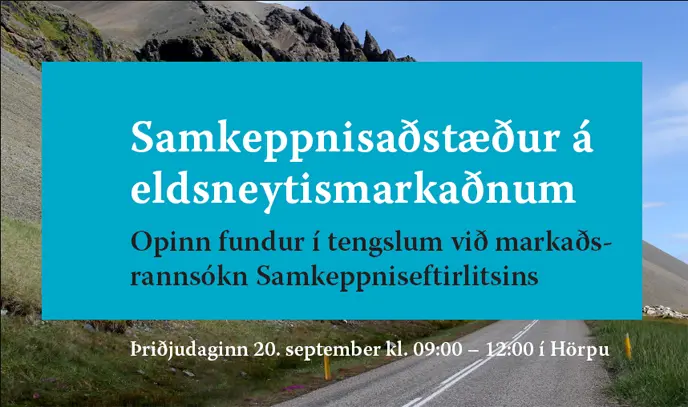
- An open meeting is held where stakeholders and others have the opportunity to present their views on the draft assessment report.
- A decision is made on how to conclude a market research, which may consist of one or more of the following solutions:
- The powers in Article 16 to amend the conduct and/or structure of undertakings are applied.
- The powers of Article 16 are applied to restrictive practices by public authorities.
- A special investigation has been launched into a possible breach of competition law prohibition rules or of instructions in decisions by competition authorities.
- Opinion and/or recommendations.
- If the findings of an investigation do not lead to a binding intervention, they are set out in a publicly published report.
What measures can the organisation take following market research?
If a market investigation by the Competition Authority leads to the conclusion that it is necessary to intervene in the relevant market, it may, pursuant to Article 2. subsection 16 of the Competition Act, may include any measures necessary to strengthen competition, stop infringements or respond to acts by public authorities that may have an adverse effect on competition. The Competition Authority may apply the necessary remedies to alter both conduct and structure, in proportion to the infringement committed or the circumstances or conduct in question.
The Competition Authority thus has the power to intervene, as set out above, even where a company has not breached competition law or where a merger is not anti-competitive.
If the Competition Authority considers that an injunctive decision may be taken following a market investigation, including remedies for changes to the conduct and structure of undertakings, a statement of objections shall be issued in connection with the aforementioned preliminary assessment report, pursuant to Article 8 of Regulation No 490/2013. The objection statement shall otherwise be handled in accordance with Article 17 of Regulation No 880/2005 on the procedure of the Competition Authority.
An investigation, or part thereof, which leads to a binding intervention, is concluded by a decision of the Competition Authority pursuant to Chapter IV of the Rules of Procedure of the Competition Authority No. 880/2005, in accordance with the second paragraph of the aforementioned Article 10 of the Rules of Procedure No. 490/2013.
In accordance with paragraph 1 of the aforementioned Article 10 of Regulation No 490/2013, the Board of the Competition Authority considers the results of market investigations and is presented with them, for approval or refusal, decisions based on the investigation which involve intervention pursuant to paragraph 1(c) of Article 16 of the Competition Act or other provisions of the Act.
Decisions by the Competition Authority to intervene, pursuant to the aforementioned second paragraph of Article 16 of the Competition Act, may be appealed to the Competition Appeals Board, in accordance with Article 9 of the Competition Act.
In accordance with c-item of the first paragraph of Article 8 of the Competition Act, the Competition Authority has the task of ensuring that the actions of public authorities do not restrict competition and of advising the government on ways to make competition more effective and to facilitate the entry of new competitors into markets. If the findings of a market investigation are that the regulation or the administration by the authorities constitutes a restriction of competition within the meaning of paragraph c of the first subparagraph of Article 16 of the Competition Act, the Competition Authority may issue an opinion or recommendations to the relevant authorities, pursuant to Article 9(d) of Regulation No 490/2013, pursuant to Article 18 of the Competition Act and Article 24 of the Rules of Procedure No 880/2005.
It should be noted in this context that on 4 April 2017, the Competition Authority published four opinions and recommendations to the government following the outcome of a market investigation into the fuel market, namely the following opinions of the Competition Authority no.:
- 1/2017 Restraints on competition in the fuel market Opinion to the Minister of the Environment and Natural Resources, ,
- 2/2017 Restrictive practices in the fuel market, opinion to the City of Reykjavík,
- 3/2017 Restrictions on competition in the fuel market Opinion to the Minister for Transport and Local Government and
- 4/2017, Restrictions on the fuel market, opinion to the Transport Equalisation Fund.
Market research on the fuel market
The Competition Authority has published Report No. 2/2020 , Changes to the fuel market – addressing the barriers to competition identified in the Competition Authority's market study. The report reviews the barriers to competition that were discussed in the preliminary assessment report on the supervisory authority's market study, published at the end of 2015 (2/2015) , and an account is given of the changes that have occurred as a result of, or in connection with, that research.
Since the Competition Authority presented its preliminary assessment and suggested ways to remedy the situation, it has issued four opinions to the government, recommending measures to address conditions that are detrimental to competition. Furthermore, companies in the market have taken and committed to changes in connection with subsequent administrative proceedings, in line with the Authority's preliminary assessments in those cases, which are aimed at facilitating competition. In this regard, the following opinions, decisions and settlements may be mentioned:
- Opinions No. 1/2017 and 2/2017 – Restrictive practices in the fuel market, in which recommendations were made to the Minister of the Environment and Natural Resources and the City of Reykjavík to improve the framework for planning and land allocation. The recommendations have not been acted upon.
- Opinions No. 3/2017 and 4/2017 – Restrictions on competition in the fuel market, in which recommendations were made to the Minister of Transport and Local Government and the Transport Equalisation Fund to amend the fund's framework. The recommendations were acted upon.
- Decision No. 8/2019, Merger of N1 hf. and Festi hf, where the merging parties committed themselves m.a. the sale of petrol stations in the capital region and the 'Dælan' trademark to a new party, and changes to the framework for fuel procurement and distribution, both of which are intended to enhance competition.
- Decision No. 9/2019, Merger of Haga hf., of Haga hf., Olíuverzlunar Íslands hf. and DGV ehf., in which the merging parties undertook, among other things, the sale of petrol stations in the capital region to a new party and changes to the framework for fuel storage and distribution.
- Settlement of Olíudreifing (ODR) with the Competition Authority regarding increased access for resellers to wholesale fuel and increased access to the services of Olíudreifing ehf. The settlement was made in connection with the resolution under points c and d above.
- Decision No. 39/2020, Improved competitive conditions for the sale of aviation fuel at domestic airports, where a settlement for the case ensures equal and objective access to the sale of fuel at domestic airports.
It has now been ensured that there is fair and objective access to the facilities of Icelandic Tank Storage ehf. in Helguvík for the sale of aviation fuel. These solutions are discussed in more detail in the report.
In light of the above, there have been significant changes in the fuel market since the market study was conducted. These changes are likely to facilitate competition in the market, although it is not yet clear what their ultimate impact will be. In the opinion of the Competition Authority, these reforms are likely to facilitate the development of energy markets and create a more efficient framework for the forthcoming energy transition. In this area, there are various challenges that the Competition Authority is considering.
During the market investigation, it was not necessary to apply intervention pursuant to subsection 1(c) of Article 16 of the Competition Act, which authorises the Competition Authority to intervene in situations that hinder competition, even if they are not attributable to breaches of competition law. It is positive that changes have occurred in the market without it being necessary to resort to that provision.
Video – The meeting in its entirety
Video – Guðrún Ragnarsdóttir, Chairperson of the Competition Authority –
Videos – Frosti Ólafsson, Hermann Guðmundsson, Johannes Gunnarsson, Tryggvi Axelsson
Here, Frosti Ólafsson (Managing Director of the Business Council), Hermann Guðmundsson (Managing Director of KEMI), Jóhannes Gunnarsson (Chairman of the Consumer Association) and Tryggvi Axelsson (Director of the Consumer Authority) answer the following questions.
- Why is the price of vehicle fuel higher here than almost anywhere else?
- Are competitive considerations given sufficient weight in local authority planning?
- How can competition in the fuel market be increased?
Video – Key findings of the Competition Authority's preliminary assessment report on the fuel market.
Video – A summary of stakeholder perspectives on barriers to access and coordinated behaviour in the fuel market.
Video – A summary of stakeholder perspectives on price comparisons, mark-ups, profitability and possible improvements to the fuel market.
Video – A summary of interviews conducted by the Competition Authority with the director-general of the German competition authority, representatives of the British and Portuguese competition authorities, and Severin Borenstein, a professor of economics at the University of California, Berkeley.
Video – Panel I
Video – Panel II
Video – Final words of Páll Gunnar Pálsson
Agenda
The meeting in its entirety – Video
Guðrún Ragnarsdóttir, Chairperson of the Competition Authority – Video
| Time | Event |
|---|---|
| 9:00 – 9:20 | Competition in foreign fuel markets – Video
The Competition Authority will publish interviews with the following parties: Andreas Mundt, President of the German Federal Cartel Office and Chair of the steering group Severin Borenstein, professor of economics at the University of California, Berkeley and chairman of the committee John E. Gata, an expert at the Portuguese Competition Authority |
| 9:20 – 9:30 | Key findings of the Competition Authority's preliminary assessment report – Video |
| PALLBORÐ I – Video Are there anti-competitive barriers to entry and is there coordinated behaviour between the oil companies in the sale of vehicle fuel? |
|
| 9:30 – 10:30 | Participants: – Video
John Björnsson, CEO of Festi |
| 10:30 – 10:50 | Break |
| PALLBORÐ II – Video What criteria should be used when assessing competition in the Icelandic fuel market, and can competition in it be increased? |
|
| 10:50 – 11:50 | Participants: – Video
Runólfur Ólafsson, Director of the RAC |
| 11:50 – 12:00 | Páll Gunnar Pálsson, Director-General of the Competition Authority – Video |
Please register for the conference by sending an email to samkeppni@samkeppni.is
You can take part in the preparation for the meeting by submitting questions for a panel discussion. Please send them to samkeppni@samkeppni.is
(Posted online 12.09.2016)
Here, Frosti Ólafsson (Managing Director of the Business Council), Hermann Guðmundsson (Managing Director of KEMI), Jóhannes Gunnarsson (Chairman of the Consumer Association) and Tryggvi Axelsson (Director of the Consumer Authority) answer the following questions:
- Why is the price of vehicle fuel higher here than almost anywhere else?
- Are competitive considerations given sufficient weight in local authority planning?
- How can competition in the fuel market be increased?
Jóhannes Gunnarsson, chairman of the Consumers' Association
Frosti Ólafsson, Director General of the Business Council
Hermann Guðmundsson, CEO of KEMI
Tryggvi Axelsson, Director of the Consumer Authority
Below you can find documents and other information that the Competition Authority has published in connection with the investigation.
- Questions and answers regarding the preliminary assessment report (2 March 2016)
- Part Three of the preliminary assessment report, preliminary assessment and possible improvements (30.11.2015)
- Summary of the preliminary assessment report (30 November 2015)
- The preliminary assessment report in PDF format (30.11.2015 - updated 22.12.2015)
- Annex A.1 Definition of geographical markets
- Appendix A.2 Cost-benefit analysis
- Appendix A.3 Supply Area Analysis of Fuel Stockpiling
- Appendix A.4 Supply Area Analysis of Retail Alternative Fuels
- Appendix B.1 Development of retail market share
- Appendix B.2 Market share in inventory holding
- Appendix B.3 Consumer awareness among individuals
- Appendix B.4 Consumer survey among businesses
- Vidauki-B.5 Management and Ownership Relationships
- Appendix C.1 Conforming Behaviour
- Appendix C.2 Price Leadership Analysis
- Appendix C.3 Asymmetric truth-telling
- Appendix C.4 Description of the oil companies' discount arrangement
- Appendix C.5 Official Competition Hams
- Annex D.1 Opinion on the transfer of non-oil products
- The Federation of Icelandic Trade Unions (16 March 2016)
- Atlantic Oil (16 March 2016)
- Festi (16.3.2016)
- Association of Icelandic Car Owners (16 March 2016)
- Fljótsdalshérað (16 March 2016)
- Transport Equalisation Fund (16 March 2016)
- Value (16 March 2016)
- Icelandair (16 March 2016)
- National Association of Pension Funds (16 March 2016)
- Civil Service Pension Fund (16 March 2016)
- N1 (16.3.2016)
- The Consumers' Association (16 March 2016)
- Consumer Agency (16 March 2016)
- Oil spill (16 March 2016)
- Oil Trading of Iceland (16 March 2016)
- Hringbraut: Director-General of the Competition Authority – Billion-pound consumer losses due to collusion by the oil companies? (11.12.2015)
- The Mirror RÁS 1: Price controls a last resort if measures fail. (01.12.2015)
- RÚV News Agency: The price of fuel is very important to consumers. (30.11.2015)
- Society CHANNEL 1: Coordination of the oil companies not necessarily illegal. (30.11.2015)
- Bylgjan – Reykjavík in the afternoon: Not proof that anyone has done anything wrong. (30.11.2015)