
The Icelandic Competition Authority („the ICA „) has by decision
no. 33/2023 completed the investigation into Samskip’s suspected Competition
law violations. The ICA concludes that Samskip gravely violated the prohibition
of Article 10 of the Icelandic Competition Act and Article 53.1 of the EEA
Agreement with unlawful collusion with Eimskip.
It is also the ICA’s conclusion that Samskip, during the case
investigation, gravely violated Article 19 of the Icelandic Competition Act
with incorrect, misleading, and insufficient information and data delivery.
An administrative fine for these violations has been imposed in the sum
of ISK 4.2 bn. (ISK 4.200.000.000).
Furthermore, certain instructions are addressed to Samskip to prevent
further violations and promote competition.
The investigation into Eimskip’s violations ended in June 2021, with the
company’s settlement with the ICA. With the settlement, Eimskip admitted
violation, paid an administrative fine of ISK 1.5 bn. and committed to take
certain measures to prevent further violations and promote competition.
Regarding Samskip’s violation, the decision states as follows:
„The collusion between Samskip and Eimskip as a whole was intended
to enable the companies to significantly reduce competition and raise or
maintain prices, e.g., by raising prices when contracts were being renewed, by
raising prices and fees in price lists, by introducing new fees, by reducing
discounts, etc. The joint dominant position of Eimskip and Samskip in the
market, the communication between the companies’ managers, and other factors in
the companies’ collusion created ideal conditions for the companies to succeed
in the collusion and profit at the expense of customers and society as a whole.“
With this decision, the investigation into Samskip’s suspected
violations of the prohibition on unlawful collusion is completed. It is the
conclusion of the Icelandic Competition Authority (“the Competition Authority”
or “ICA”) that Samskip gravely violated the prohibition of Article 10 of the
Icelandic Competition Act and Article 53.1 of the EEA Agreement with unlawful
collusion for an uninterrupted period between 2008 and 2013 (the main
investigation period), as well as certain violations that occurred before this
period. It is also the ICA’s conclusion that Samskip, during the investigation
of the case, seriously violated Article 19 of the Icelandic Competition Act
with incorrect, misleading and insufficient information and data delivery. An
administrative fine for these violations has been imposed on Samskip hf. and
Samskip Holding, in the sum of ISK 4.2 bn. (ISK 4.200.000.000).
The investigation initially involved Samskip and
Eimskip. The investigation into Eimskip’s violations ended in June 2021, with a
settlement the company made with the ICA. With the settlement, Eimskip admits
„to having been in contact and cooperated with Samskip in a way that constituted
serious violations against Article 10 of the Competition Act and Article 53 of
the EEA Agreement“ (prohibition of unlawful collusion). With the
settlement, Eimskip commits to take certain measures to prevent further
violations and promote competition. The company also admits „having
violated Article 19 of the Icelandic Competition Act by not having provided the
necessary or correct information or failed to hand over data for the benefit of
the Icelandic Competition Authority’s investigation“. Due to the above
violations, Eimskip paid an administrative fine in the amount of ISK 1.5 bn. The
amount of the fine reflects that an account was taken of the general rule that
companies are subject to lower fines than otherwise if they come forward,
acknowledge violations and undertakes to take action in order to prevent
further violations.
When it became clear to Samskip that Eimskip was in
settlement negotiations with the ICA, the company also requested settlement negotiations.
After the negotiations had taken place in June and July 2021, it became clear
that they would not produce a result that, in the opinion of the ICA, contained
a satisfactory conclusion to the case, so the negotiations with Samskip were
therefore discontinued.
As the settlement negotiations with Samskip ended
without a result, in this decision it is concluded whether and how the company
violated Icelandic competition law in the case under investigation. After the
investigation of the case against Eimskip was completed, the ICA took Samskip’s
counter arguments into further consideration and gave the company further
opportunities to express its views on certain issues under investigation in the
case.
The
investigation into the conduct of Samskip and Eimskip was initiated on the
basis of tipoffs that the ICA received from, among others, customers of the
companies. The tips were considered to provide ample evidence that key managers
of the companies were in considerable contact with each other and that the
companies were engaging in illegal collusion, which i.a. manifested in the fact
that they did not compete for each other’s important customers. The
investigation revealed that the tipoffs were well-founded.
The
investigation of the case began with dawn raids at Samskip and Eimskip in the
fall of 2013, based on the court rulings of the Reykjavík District Court. On
the same day and the following days, the ICA took oral reports from several of
the companies’ managers and recorded them. After the first processing of the
data obtained during the dawn raids, the ICA then carried out another dawn raid
at the companies offices in the beginning of summer 2014. At the same time,
further requests for information and data were directed at the companies during
the investigation.
From
the outset, the investigation has been given priority by the ICA. The case is very
extensive in nature and substance. Thus, the investigation of the case involved
most aspects of the activities of two large companies that had operations in a
number of countries. Under investigation were continuous and wide-ranging violations
which lasted for many years. The scope of this investigation has no precedent
in competition enforcement history in Iceland. It can be mentioned that the
copied and seized data amounted to about 4 terabytes, which corresponds to tens
of millions of documents and e-mails.
It
had substantial impact on the investigation procedure that at the beginning of
the investigation, both Samskip and Eimskip repeatedly gave incorrect,
insufficient or misleading information about the relations and cooperation
between the companies. This was first done during questioning of the respective
managers in connection with the dawn raids at the companies offices.
Furthermore, the companies did not provide important information or deliver
data to the ICA‘s subsequent information requests. This conduct of the
companies resulted in significant delays in the investigation of the case. With
Eimskip’s settlement with the ICA, the company admitted to having violated the
information obligation of Article 19 of the Icelandic Competition Act and
consequently paid administrative fines. In this decision, it is concluded that
Samskip has violated Article 19 and administrative fines are imposed on the
company as a result. It is stated that these violations of Samskip of Article
19. were extensive, serious and impeded substantially the effectiveness of the
investigation.
During
the investigation of the case, the Competition Authority published two Statements
of Objection („SO“) to the companies in which a detailed account of the
preliminary findings of the investigation was given. The previous SO was
published to the parties mid-year of 2018 and the companies were invited to
express their comments and views. The second SO was published to the companies
at the end of 2019.
The
publication of two SO‘s served to give the companies more room to express their
views and speed up the processing of the case. However, both companies decided
not to take advantage of it. Upon publication of the first SO, Samskip decided
to refuse to present their comments and views until the second SO was
available. Eimskip initially announced that it intended to exercise its right
to object due to the first SO and requested repeated deadlines for that
purpose, but later changed its mind and decided not to comment until the second
SO appeared.
The
companies’ points of view regarding the preliminary findings by the Competition
Authority were therefore not received until well into 2020. Samskip’s final
comments on the SO‘s were not submitted until the end of August 2020, or over
two years after the first SO was delivered and over eight months after the
second was published. Both companies objected to ICA‘s preliminary findings and
denied having violated Article 10 of the Icelandic Competition Act and Article
53 of the EEA Agreement.
Due
to further investigation, i.a. as a result of the views expressed by Eimskip
and Samskip, a letter was written to the companies at the end of November 2020,
where they were given access to further data and given the opportunity to
exercise their right of objection.
As
mentioned above, Eimskip decided to reach a settlement with the Competition
Authority in June 2021. In connection with that, Samskip also requested
settlement negotiations, but they were unsuccessful. During further
investigation, three letters were written to Samskip, i.e. in May and July 2022
and March 2023, in which the company was i.a. granted access to additional data
and given the opportunity to exercise its right to object.
Investigation
submitted to the Appeals Committee, the Courts and the Parliamentary Ombudsman
During
the investigation of the case, the case has been referred seventeen times to
the Competition Appeals Committee and the courts. In this way, the companies
have sent seven appeals to the Appeals Committee, and issues related to the
investigation have come before the Reykjavík District Court five times and have
been brought before the Court of Appeal three times.
The disputed
issues at the Appeals Committee and the courts can be broadly divided into
three.
Firstly,
Eimskip’s and Samskip’s access to search warrants and other data during the
first two years of the investigation. These access issues were resolved by the
Appeals Committee and the courts.
Secondly,
the investigation was brought before the courts and the Appeals Committee in
2019 and 2020, mainly by Eimskip. Before the Appeals Committee, the company
tried to receive certain data and information from the Competition Authority.
The company then demanded twice before the District Court that the
investigation of the case be discontinued and the case data destroyed. The
company also believed that certain employees of the ICA were disqualified to
handle the case. The company’s claims were dismissed by the District Court in
the first case, and the Court of Appeal confirmed that decision. The latter
case was dropped by the company shortly before the company requested settlement
negotiations.
Thirdly,
Samskip has attempted to have certain provisions of Eimskip’s settlement with
the Competition Authority invalidated, but those provisions concern the end of
the cooperation between the companies. The judgment of the District Court in
that case has been appealed to the Court of Appeal, where the case is now
waiting to be heard.
In
2015, Eimskip also filed a complaint with the Parliamentary Ombudsman regarding
the case procedure and enforcement practices of the Competition Authority. The Ombudsman
agreed to investigate the matter and requested information from the ICA. After
receiving the Competition Authority’s answers, the Ombudsman did not consider
it necessary to act further on the complaint.
Chapter
2 of this decision contains an overview of the procedure of the case, and Annex
II provides a detailed account of the individual aspects of the case procedure
in chronological order.
Charges
filed to the District Prosecutor‘s office
According
to Article 42 of the Icelandic Competition Act, the Competition Authority shall
assess, with regard to the gravity of the offense and with regard for administration
of justice, whether that aspect of the case that concerns the criminal
responsibility of an individual should be reported to the police, while the District
Prosecutor‘s office investigates and prosecutes criminal cases based on violations
of the Icelandic Competition Act.
The
provisions of Article 42 also allow the mutual sharing of information between
the Competition Authority and the police authorities. The Competition Authority
is also authorized to be involved in measures
taken by the police in relation to investigation of violations of the Icelandic
Competition Act and the police is in the same way authorized to be involved in measures
taken by the Competition Authority.
During
the investigation of the case, the Competition Authority has three times filed
charges to the District Prosecutor‘s office regarding certain employees of
Samskip and Eimskip. This was done in 2014, 2016 and 2018. During the
investigation of the case, the Competition Authority has also shared data and
information with the District Prosecutor in accordance with the above-mentioned
provisions and assisted the DP office during questionings. The District Prosecutor
has also granted the Competition Authority access to data and reports that have
been used in the investigation of the case and thus constitute part of the case
file.
During
the District Prosecutor’s investigation, two managers of Samskip and two
managers of Eimskip received legal status as defendant’s. According to the
information of the Competition Authority, these individuals still have legal
status of defendants. The DP
investigation is well underway but is has not been completed yet.
As stated
here previously, it is the conclusion of the ICA that Samskip has seriously
violated the prohibition of Article 10 of the Icelandic Competition Act and
Article 53.1 of the EEA Agreement with unlawful collusion for an uninterrupted
period between 2008 and 2013, as well as certain violations that occurred
before this period. The breaches of Samskip include the following:
Samskip’s
violations were serious, extensive and lasted for a long period of time, in
markets where the parties to the collusion had a dominant position, where they
had during the period a combined share of over 90% market share in maritime
transport between Iceland and Europe, a combined share of 100% in maritime
transport between Iceland and North America and a combined share of 75-80% in
land transport overall. The companies have been among the largest companies in
Iceland and their income from transport activities amounted to 2.6% of GDP (i.e.
the value of all goods and services that are produced and offered each year).
Competition
in transport is very important for the standard of living of the public and the
competitiveness of the Icelandic economy. It was therefore of great economic
importance that Eimskip and Samskip respected the ban on any kind of
anti-competitive collusion between competitors. Otherwise, consumers, companies
and the national economy as a whole could incur considerable economic losses.
Events
leading up to increased collusion
The
case data shows that in the first half of 2008, Samskip hf. in Iceland was
considering how to respond to the worsening economic outlook and falling demand
for imported goods. Two approaches were considered. On the one hand, increasing
Samskip’s competition with Eimskip, i.e. to reach out to Eimskip’s customers
and improve the utilization of ships. On the other, increasing Samskip’s collusion
with Eimskip. The latter was chosen.
Although
the operation of Samskip hf. in Iceland was successful, Samskip Holding B.V.
i.e. the Dutch parent company of Samskip Group, and its main owner, faced
financial challenges in 2008. On the one hand due to the demands of Samskip
Holding’s main lender, Fortis Bank, and on the other hand due to challenges
faced by the main owner of Samskip through investment companies as the second
largest owner of Kaupthing Bank hf. on the eve of the economic collapse in
Iceland.
In
March 2008, the main owner of Samskip instructed the board members and key
managers to take action to protect and strengthen Samskip’s position in Iceland
as a „Cash Cow“ for the Samskip group („…maximise
the business and protect the Cash Cow which Iceland has been for the Group„).
In this way, clear instructions were directed to, among others, CEO of Samskip
in Iceland to ensure and increase the flow of funds from the operations in
Iceland to Samskip Holding. The data show that the main owner of Samskip
encouraged the CEO of Samskip to exert himself in the collusion with Eimskip,
i.a. with the promise of a bonus payment.
At
the same time, Eimskip was facing great financial difficulties, that were
mainly caused by debts attributable to investments abroad. In May 2008, there
was a change of CEO at Eimskip, but in an email from the CEO of Samskip to the
main owner of Samskip, his assessment was that with the change, „the
flexibility will be greater, and the hardness will be reduced„. Furthermore,
the CEO of Samskip said that he knows the new CEO of Eimskip well.
This
and other relationships between the key managers of Samskip and Eimskip
undoubtedly made it easier than otherwise for Samskip to approach Eimskip with
the aim of increasing the illegal collusion between the companies. The
communication and connections served to maintain the illegal collusion
throughout the investigation period of this case.
Decision
on extended collusion
The
data of the case show that Samskip and Eimskip had at least since 2001, been active
in an illegal collusion, but the most serious violations of this case began during
the events leading up to the economic collapse in 2008. On June 6, 2008,
the main owner of Samskip, the CEO of Samskip, the chairman of the board of
Eimskip and the new CEO of Eimskip met in the offices of the investment company
of the main owner of Samskip, Kjalar. At this meeting, Samskip and Eimskip
decided to start a project that the companies named „New beginning„.
This project had the effect of distorting competition within the meaning of
Article 10 of the Icelandic Competition Act and was illegal.
The
purpose of the project was to evaluate the benefits to the companies of „extending“
the illegal collusion of the companies that existed at the time. The collusion
that was already in place in June 2008 involved, among other things, the
following:
In the „New beginning“ project,
Samskip and Eimskip decided to exchange sensitive information and evaluate
together the benefits of extending cooperation in key areas of their
operations. This included liner sailing schedules, maritime transport to and
from Iceland, market sharing, ship handling
in Iceland, land transport in Iceland, subsidiaries in Norway that handled the
export of frozen fish from i.a. Iceland and Norway, freight forwarding,
maritime transport between ports on the European continent (so-called
„short sea“ transport) and cold storage operations in the
Netherlands.
During
the period of the investigation, managers of the companies who were directly involved
in the collusion had a number of meetings and conversations. Between June 2008
and January 2009, the respective managers had at least 19 meetings where they
discussed the different tasks of the collusion project. In addition to that,
data from the period shows that the respective managers had, in at least 18
cases, communication by phone or email during this same period.
Contemporary
data also shows that during the period from 2009 to September 2013, managers
and key employees of these two companies were in contact at least 160 times, at
meetings, via phone calls, at golf tournaments, during travel, at dinner
parties or in other ways. Emails between the companies are not included in the
count. Chapter 13 of the decision outlines these communications, as well as
their significance to the case.
Among
the important evidence of Samskip’s violations are internal documents from the
companies, especially e-mails between colleagues, which shed light on the
preparation of the collusion within each company individually. The data sheds
light on the preparation and subject of meetings and other communications
between the companies, as well as the preparation and implementation of the collusion
in other respects. Thus, the data show i.a. in a detailed way how the companies
coordinated their actions during the preparation and implementation in
different areas of the collusion.
In
the above-mentioned communications between Samskip and Eimskip during the collusion
period, there were repeated discussions between managing directors and other
directors, who, among other things, were responsible for liner sailing schedules,
land transport schedules, pricing of transport services and other competitive
aspects of the companies’ services. The data show that the discussions between
the companies extended to key areas of the companies’ transport activities and to
competition between them.
Second
half of 2008: The foundations of the extended collusion laid
In
the latter part of 2008 work was carried out on all aspects that fell under the
aforementioned „New Beginning“ project, including limitation
of transport capacity and increased cooperation in maritime transport.
Deteriorating economic conditions resulted in a decline in imports to Iceland.
It was clear that unused transport capacity was costly to the companies and
created an incentive for increased price-competition in order to attract
increased transport volume. At the same time, Samskip’s management projected
that transport with the same ships from Iceland would increase, not least due
to Samskip’s increased transport of aluminum for Alcoa Fjarðarál. Measures were
taken i.a. to limit import carrying capacity, but at the same time to have
sufficient export carrying capacity to maximize revenue from important
exporters such as Alcoa and the fishing companies.
An
important milestone in the collusion between Samskip and Eimskip was reached in
the late summer and autumn of 2008, with changes in liner sailing schedules and
limitation of transport capacity. At the same time, the companies consulted on
various types of support measures in order for the collusion as a whole to
succeed. In connection with Samskip’s decision at the end of October 2008 to
reduce the number of ships in sailings to and from Iceland from four to three,
Eimskip e.g. undertook to transport part of the aluminum that Samskip would
have otherwise transported for Alcoa. On the basis of the collusion, Samskip
was able to reduce services to Aloca on the one hand and increase prices by
131% to that same important customer. Within Eimskip, there was great
satisfaction with the transport business the company acquired on the basis of
the collusion and described this, among other things, as „ecstasy„.
Eimskip also undertook to transport signficant volume from the UK to Iceland
for Samskip. At the same time, the key managers of the companies were
repeatedly in illicit contact with one another. At the same time, both
companies were preparing significant price increases and were in contact with
each other about issues relating to their price decisions.
Official
and other data show that the great economic difficulties that hit the world in
the fall of 2008 had the effect, both in Iceland and in neighboring countries,
that the demand for the services of transport companies decreased
significantly, and that important buyers of such services demanded better prices
as their activities became more difficult. This situation led to fierce price
competition on foreign transport markets and, for example, it was stated in
Morgunbladid news on October 30, 2008 that „freight rates have never
decreased so much„.
As a
result of the collusion between Samskip and Eimskip in Iceland, the companies
were able to repeatedly raise prices in the latter part of 2008. As a sign of
this, Samskip’s CEO declared in October 2008 that the company had achieved
„massive increases„. The reaction of one of Eimskip’s customers
to the company’s price increase in November 2008 was: „Are you crazy?
Who accepts an 80% increase?“ Contemporary data confirms numerous
complaints from the companies’ customers objecting to price increases, e.g.
citing a significant drop in oil prices and an unprecedented drop in shipping prices
in shipping markets abroad. Because of the collusion, Eimskip and Samskip, on
the other hand, did not have to fear competition from each other and were able
to ignore complaints and protests.
This
part of the investigation is discussed in detail in chapters 8-11 of this
decision.
„The
Peace“: 2009-2012
As
outlined above, Samskip and Eimskip had taken important measures in the second
half of 2008 in order to ensure that their collusion would be successful in the
difficult economic circumstances in Iceland at the time.
At the
time, a relatively small group of large customers was by far the most important
for the operation of both Samskip and Eimskip. At a certain point in time, 38
out of a total of 1800 customers accounted for 66% of Samskip’s revenue from
transport to Iceland. In such circumstances, there is an obvious risk that the
collusion of competitors to reduce transport capacity will not be sufficient to
raise prices or prevent falls in prices. Thus, an important customer of either
company can seek offers for its entire transport purchases, and the other
company may believe that it will benefit more from winning the customer over instead
of honouring the collusive agreement.
Samskip
and Eimskip prevented this risk through illegal market sharing. Accordingly,
Eimskip has admitted that after June 6, 2008, it colluded „with Samskip
about market sharing of larger customers in maritime and land transport.“
This involved that the companies would not compete for and try to win over such
customers from each other.
The
aforementioned admission by Eimskip is fully consistent with contemporary data,
as during most of the period in question important customers did not move from
Samskip to Eimskip and vice versa. It made no difference although the customers
repeatedly requested offers for their business, i.a. by means of tender arrangement
or tried in other ways to get better terms and protect themselves from price
increases by Samskip and Eimskip.
The
collusion between Samskip and Eimskip as a whole was intended to enable the
companies to significantly reduce competition and raise or maintain prices,
e.g. by raising prices when contracts were being renewed, by raising prices and
fees in price lists, by introducing new fees, by reducing discounts, etc. The
joint dominant position of Eimskip and Samskip in the market, the communication
between the companies’ managers and other factors in the companies’ collusion
created ideal conditions for the companies to succeed in the collusion and
profit at the expense of customers and society as a whole.
An
example of the above is Ölgerðin’s tender in 2009 Ölgerðin was one of Eimskip’s
most important customers. At the beginning of 2009, Ölgerðin was extremely
unhappy with the large increases in prices for Eimskip’s ocean freight
services, which were
inconsistent with the existing contract between the two companies. Furthermore,
Ölgerðin considered the prices for Eimskip’s ground transportation services to
be „ridiculous„. Within Eimskip, on the other hand,
nothing was done about these complaints, as Eimskip did not have to fear
competition for Ölgerðin‘s business due to the collusion with Samskip. Instead,
Eimskip’s managers shared Ölgerðin’s complaints with each other for „fun„.
As a
result, Ölgerðin decided to tender all of its transport purchases. Shortly
before the opening of the tender, five of Samskip’s senior managers held a
„contest“ among themselves, in which they guessed Eimskip’s
tender price. The guesses of all the managers were based on the assumption that
Eimskip would offer a lower price than Samskip in each area of the tender. The
thrill/contest between Samskip’s managers was about which of them would guess
Eimskip’s correct offer price, and not whether Samskip would win the business of
Ölgerðin.
The case
data thus shows that Samskip’s offer to Ölgerðin was a pseudo offer. The collusion
between Samskip and Eimskip enabled Eimskip to keep the business and increase
the price to this customer. At a meeting in Eimskip‘s headquarters, there was
great satisfaction with the result, and a manager at the company emphasised
this to his subordinates: „Have made it clear that we should generally
not lower prices. Instead we need to raise prices […] Shipping
volume could be more these days„.
The market
situation that resulted from the collusion is described in contemporary
documents of the companies as „peace“ (or „calmness“ in the
market). Instead of effective competition for important customers,
„peace“ prevailed and mutual certainty remained about the
competitor’s response. On that basis, the companies focused on keeping prices high
or increasing them.
One
manifestation of this was that both Samskip and Eimskip assumed in their
financial plannings that they would be able to repeatedly raise prices and at
the same time keep their most important customers.
At
the beginning of the investigative period, the economic environment abroad was
very weak and the business
situation was difficult in the transport sector there. Samskip Holding
operated transport services in various European countries other than Iceland.
In the minutes of the company’s board meetings, it is stated that there has
been a sharp decline in demand in foreign transport markets. Contemporary data show that the company’s customers in the foreign
transport markets where the group operated, pushed for price cuts. It is also
clear that the economic downturn lead to falls in the prices of important inputs,
such as oil and ship rentals, went down, which in turn created room for price cuts.
In the minutes of Samskip Holding’s meetings, it is stated that this has led to
intense and even desperate competition in the foreign transport markets. This
had a significant impact on the operating performance of the company’s
subsidiaries. In the same minutes of Samskip Holding, a completely different
situation was described in respect of Samskip hf. in Iceland.
In
these minutes of Samskip Holding’s meeting, it is stated that they are
extremely satisfied with the performance of Samskip hf. in Iceland. Examples of
this are:
·
In the minutes of a meeting from April 2009,
it is stated that the EBITDA of the sister companies of Samskip hf. are
significantly below plan, but the group as a whole was on plan. The reason for
this is attributed to the excellent results of the Icelandic operations:„This is mainly due to to extremely good
results from Iceland“.
·
In the minutes of a meeting from May 2009, it
is stated that the EBITDA of the group as a whole exceeds the plan, and the
reason is again stated as follows: „continued
good results from Iceland.“
·
The CEO of Samskip hf. declared that 2010 had
been a „great year“ and that he and key executives deserved
bonuses for „outstanding results„. Furthermore, he believed
that the year 2011 was „a very good year„.
In
this regard, it should be noted that despite the fact that Samskip’s turnover
in Iceland in 2009 was only about 24% of the group’s total turnover, the
operations in Iceland generated about 82% of the group’s EBITDA. This shows the
success of Samskip hf. in Iceland as a „Cash Cow“ for the
group, just as the main owner had planned and instructed on the eve of the
extended collusion in 2008.
An
example of a manifestation of this is an e-mail that the manager of the
international division at Samskip sent to i.a. the CEO of Samskip on December
15, 2010. These key executives were in Rotterdam at the time to present, at a
meeting of the board of directors of Samskip Holding, the financial results of
the first ten months of 2010 and the plan of Samskip hf. in Iceland for 2011. In
the email merely this was stated:
„The
cash cow has arrived„
Attached
to the manager’s e-mail was a picture of a dairy cow and it was clear that it
was referring to Samskip hf. in Iceland. This is covered in more detail in the
decision, chapter 14.33.15, paragraphs 7236-7237.
2013:
The extent of the collusion reduced
In
2013, Samskip reduced its collusion with Eimskip. At the time, the economic
recovery in Iceland created an incentive for the companies to increase their
supply of transport volume in their shipping systems and withdraw from the collusion
they had started following the economic collapse in 2008. At that time, Alcoa
also withdrew its export business from Samskip and Eimskip and as a result extensive
transport volume was freed up in the shipping systems of the companies, in
particular Samskip.
—————————————————————————————————————–
* Samskip and Eimskip
operated cold storage facilities in the Netherlands which, among other things,
were used in connection with transport to and from Iceland. After a dawn raid
at Samskip, Eimskip and two other companies, the Dutch Competition Authority
imposed a fine on the companies due to illegal collusion on the cold storage
market in the Netherlands in the years 2006-2009. Eimskip decided to accept the
Dutch Competition Authority’s decision, but Samskip did not. In July 2022, the
District Court of Rotterdam confirmed the conclusion of the Dutch Competition
Authority regarding Samskip’s participation in theillegal collusion and that
the fine imposed on the company was reasonable in view of the seriousness of
its violations. In the press release of the Dutch Competition authority, i.a.
this was said about the offenses: „Between 2006 and 2009, the companies that
have been fined distorted competition in various ways. Anticompetitive
arrangements have been discovered in various emails. Competition-sensitive information
was frequently exchanged. For example, the managers informed each other about
the price for food storage. They also told each other the current utilization
rates of their storage facilities, and thus whether or not they were looking
for jobs. Sometimes they made arrangements about who would get which customer
or about what price increase would be passed on. Also, arrangements were made
about bids to potential clients, which meant that it was clear in advance who
would get the job.“
According
to Article 21 of the Icelandic Competition Act, the Competition Authority shall
apply Article 53 of the EEA agreement in Iceland. Article 53 of the EEA
Agreement prohibits anti-competitive collusion between companies and their
associations that may affect trade between member states of the EEA Agreement.
When
assessing whether a conduct has such an effect, it is based on the guidelines
of the EFTA Surveillance Authority and legal practice in other respects. It is the
conclusion of the Competition Authority that the violations in this case were
intended to affect trade between EEA countries within the meaning of Article 53
of the agreement.
The Substantive
provisions of Article 53 of the EEA Agreement are fully comparable to the
provisions of Articles 10 and 12 of the Icelandic Competition Act, as the Act
is in this respect based upon EEA/EU competition law. In this decision,
detailed arguments are presented that show that Samskip has gravely violated
Article 10 of the Competition Act. Based on the same arguments, it is the
conclusion of the Competition Authority that Samskip has violated Article 53 of
the EEA Agreement. It follows that the Competition Authority’s assessment of
whether Samskip’s conduct violated Article 10 of the Competition Act also extends
to Article 53 of the EEA Agreement.
It is
the conclusion of the Competition Authority that, during the investigation of
this case, Samskip is guilty of false, misleading and incomplete delivery of information
and data. By doing so, the company violated Article 19 of the Competition Act, but the provision grants the Competition Authority the
power to obtain data during the investigation of individual cases.
Violating the obligation to provide information and deliver data, cf. Article
37.1.i of the Competition Act, is subject to administrative fines. In Eimskip’s
settlement with the Competition Authority, the company admits to a violation of
Article 19 and pays fines.
Samskip’s
violations in this regard are that during oral disclosure, in connection with
the dawn raids at the company’s premises by the Competition Authority on 10 and
17 September 2013, the company repeatedly provided false, insufficient or
misleading information about relations and cooperation with Eimskip. Samskip’s
violations in this regard also involve not providing information or handing
over data in accordance with requests for information directed at the company
during the investigation.
These
violations were extensive and serious. They complicated and delayed the
investigation of the case, as the Competition Authority was misled and
important information was withheld from the investigation at its early stages.
Violations
of Article 19 are further discussed in chapter 23 of the decision.
According
to Article 37 of the Competition Act, the Competition Authority imposes
administrative fines on companies or associations of companies that inter alia violate
the prohibition of unlawful collusion according to Article 10 of the
Competition Act or Article 53 of the EEA Agreement. The same applies to
violations of the obligation to provide information and deliver data according
to Article 19 of the same Act.
The
decisions of the competition authority that concern violations of the Competition
Act and the corresponding fines for them are inter alia intended to have a
deterrent effect, to discourage companies from continuing to violate or repeat violations
and thuscreate the conditions for effective competition, which in the short or
long term is beneficial to the public.
It is
the conclusion of the investigation that Samskip hf., Jónar and Samskip Holding
are one and the same company (one economic unit) in the meanings of the Competition
Act. In accordance with that, the Competition Authority exercises its powers to
direct the fine at the parent company Samskip Holding, as well as Samskip hf. That
arrangement is best suited to have a sufficient deterrent effect.
When
deciding the administrative fines, the Competition Authority takes account of,
among other things, the nature and extent of Samskip’s violations, how long
they lasted, the size and turnover of the company, the combined share of
companies in the market or markets affected by the violations, the size and
importance of the market affected by the violations, the company’s part in
initiating the violations and whether the violations were implemented.
Article
37 of the Competition Act also provides for a certain maximum fine, i.e. up to
10% of the total turnover of the last calendar year of the company
participating in anti-competitive practices.
The same maximum applies in EEA/EU law. The total turnover of Samskip
Holding in the year 2022 was 137 bn. ISK.
In
the decision it is also assessed what the fines in the case might be if the
rules of the EFTA Surveillance Authority had been applied. That discussion is
presented for comparison since the ESA’s methodology for determining fines has
not been directly incorporated into Icelandic law.
The
above is described in detail in sections 35.1 – 35.2 of the decision. With
reference to that analysis, it is the conclusion of the Competition Authority
that a reasonable fine for Samskip’s violations of Article 10 of the
Competition Act and Article 53.1 of the EEA Agreement is ISK 4 bn. (ISK
4.000.000.000).
When
assessing Samskip’s violations of Article 19 of the Competition Act, the
Competition Authority takes account of, i.a., that the efficient enforcement of
competition law is not least based on compliance of the companies subject to
investigation with instructions to provide information and data. In this case,
it is clear that Samskip’s violation of the obligation to provide information
pursuant to Article 19 of the Act are extensive and serious. They undermined
the efficiency of the investigation of the case and delayed it.
With
reference to this, it is the conclusion of the Competition Authority that a
reasonable fine for violating Article 19 of the Competition Act is ISK 200 m.
(ISK 200.000.000). This is described in more detail in section 35.3.
With
this decision, cf. chapter 35.5, as previously stated, it is concluded that
Samskip has violated the prohibition of Article 10 of the Competition Act and
Article 53 of the EEA Agreement on unlawful collusion. It is also concluded
that the company has violated Article 19 of the Competition Act with incorrect,
misleading and insufficient information and data delivery. In the decision, it
is stipulated that Samskip Holding BV and Samskip hf. shall pay in solidum an
administrative fine in the amount of ISK 4.2 bn. (ISK 4.200.000.000). The
administrative fine shall be paid to the state treasury within one month of
this decision.
In
the decision, the following instructions are addressed to Samskip.
Violations
of the instructions are subject to administrative fines according to IX.
section of the Competition Act.
The
investigation into Samskip and Eimskip violations has been very extensive. It
has involved powerful international companies, concerns important markets and
covers a long period. This is the most comprehensive investigation by the ICA
that has ever been carried out in Iceland.
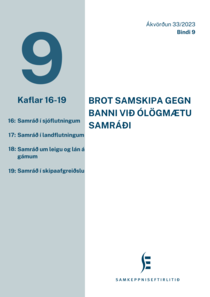
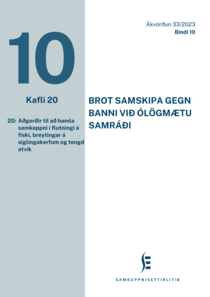
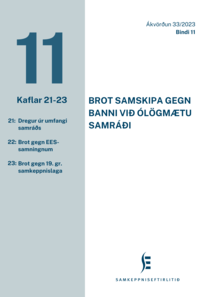
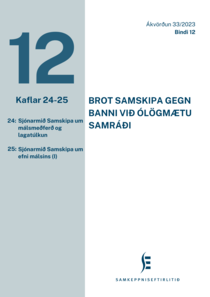
Therefore,
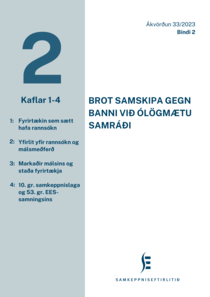
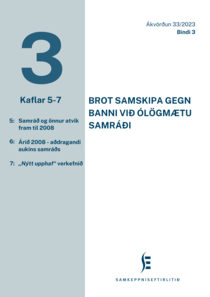
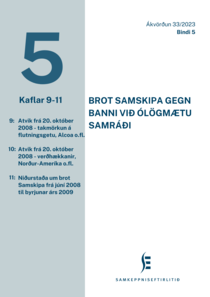
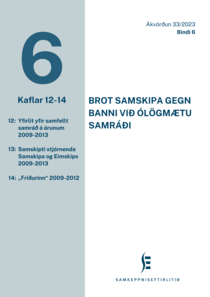
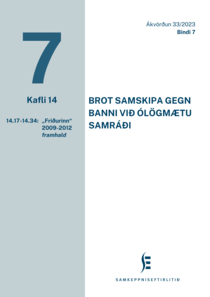
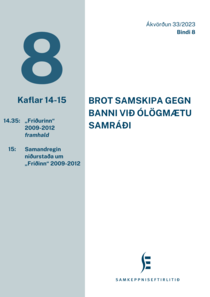
the decision in this case is very extensive. It is presented in 15 volumes and
structured as follows (volumes in Icelandic):
"*" gefur til kynna skyldusvið